
Mixed-use properties & operational planning
Boiler Repair in Medford Square
Coordinate boiler repair in Medford Square with guidance for homes, businesses, shared controls, occupied spaces, and restoration planning.
- System-specific guidance
- Clear repair questions
- You approve the work

Your property, understood
A practical guide for your address
A heating interruption near Medford Square may affect a home, a customer-facing business, or a building with several uses. The repair conversation changes when the equipment serves spaces with different opening hours, access arrangements, and decision-makers. This guide focuses on coordinating that investigation: identifying the affected load, distinguishing local distribution from central equipment, and obtaining a scope that accounts for the occupied building rather than only the boiler cabinet.
01 / LOCAL GUIDE
A commercial center with residential layers
The Historical Commission’s Medford Square overview documents a commercial center, surrounding residential development, and examples of buildings adapted to multiple dwellings. That context supports checking the present use and serving arrangement at each address. It does not establish that every storefront shares a boiler with the floors above or that a historic building retains its original heating system.
When requesting help, describe what occupies the building now and which spaces are affected. A ground-floor business that is cold while upstairs rooms remain comfortable presents a different investigation from a complete plant shutdown. The provider should identify the actual equipment and controls before assuming a common cause or recommending work that interrupts unaffected occupants.
02 / LOCAL GUIDE
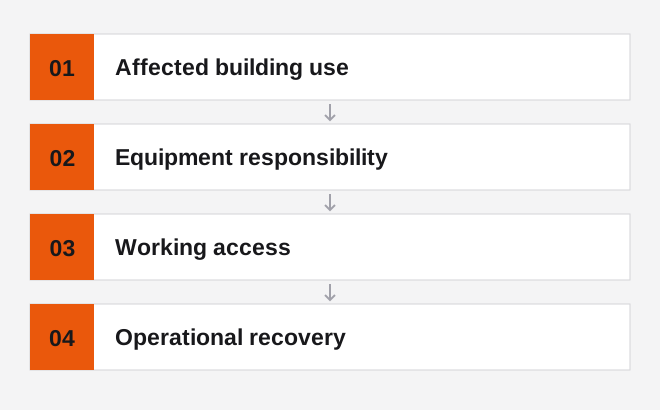
Define the interruption by use
A shop or office is cold during operating hours
Record whether the heating schedule matches the current business hours and whether the room receives any heat before opening. A control schedule, a local zone fault, or a broader distribution issue may be relevant. Changes in occupancy or door use can also affect comfort. Report those conditions as observations, not proof that the boiler lacks capacity.
Residential rooms above or beside a business are affected
The provider needs to know whether the residential area shares heat-producing equipment, distribution, or only the building envelope with the business. Separate meters or entrances do not establish the mechanical arrangement. Arrange access through the responsible contacts and distinguish household hot-water complaints from space-heating complaints before the appointment.
Several uses lose service at once
A common interruption may involve shared plant, power, fuel, or a control function, but it still needs verification. Identify which services remain available and whether any equipment reports an alarm. For a managed installation, preserve the relevant event history through normal authorized access. Do not change unfamiliar plant settings simply to clear a display before the provider arrives.
03 / LOCAL GUIDE
Coordinate the visit around the building
Identify one responsible service contact
Choose a person who can explain the reported problem, coordinate access, and reach the approval decision-maker. The roles may belong to different people, but that distinction should be clear before attendance. A provider should not have to infer authorization from whichever occupant happens to answer the door. This preparation helps define the visit without resolving legal questions about leases or ownership.
Map the affected areas and their controls
List the business spaces, apartments, or common areas reporting a problem and the controls used in each. Note whether the complaint follows an opening schedule, occurs overnight, or persists continuously. The resulting map can reveal which comparisons would be useful, while actual circuit tracing remains professional work. Do not label a boiler as serving a tenant until the connection is verified.
Discuss interruption and working access
Explain any restrictions on mechanical-room access, customer circulation, or occupied rooms. Ask the provider which equipment may need isolation for the proposed investigation. A diagnostic visit does not automatically mean the entire building must close, but continued operation cannot be assumed either. Agree communication arrangements if the scope changes and additional areas will be affected.
Confirm restoration with the original users
After the provider completes the agreed checks, collect feedback from the spaces that first reported the problem. A plant-room display showing normal operation may not demonstrate that a distant zone has recovered. Record which functions were checked and which areas were inaccessible. Any remaining limitation should be visible to the responsible property contact, not hidden within a generic completion note.
04 / LOCAL GUIDE
An illustrative mixed-use diagnostic scenario
Consider a hypothetical building where a ground-floor office is cold in the morning while the upper residential rooms remain comfortable. The office might have a schedule or zone-control problem, a distribution fault, or a room-performance issue. The provider must first identify how it is served. Replacing a shared boiler would be a substantial recommendation that needs evidence beyond this one complaint.
If the office’s emitters remain cold despite a valid demand, controls and delivery become relevant. If they warm normally but comfort is poor during frequent door opening, the assessment may broaden. This scenario is educational, not a Medford Square case study. It does not imply that this website has inspected local premises or performed the work described.
Ready to discuss your heating problem?
Share the symptoms and confirm the next step with an independent provider.
05 / LOCAL GUIDE
Three technical boundaries to clarify
Central plant versus tenant distribution
A fault can lie within the appliance or in the equipment delivering heat to one area. Ask whether the proposed scope includes the serving pump, valve, or controls, or whether another specialist must be involved. The commercial boiler guide explains how to separate plant production, distribution, and sequencing in a larger or managed installation.
Space heating versus domestic hot water
A building may use one appliance for both functions or separate equipment. State whether taps, showers, and space heating are all affected. The gas and combination boiler page describes why testing one function does not establish that the other works. Do not assume a restaurant, office, or residence has the same demand pattern as its neighbor.
Old distribution versus current occupancy
An adapted building may use its rooms differently from when the heating layout was installed. That possibility should be explored through records and inspection, not presumed from age. Ask the provider whether the proposed repair restores a failed function or changes the system to meet a new use. Those are different scopes and may require different design or approval steps.
06 / LOCAL GUIDE
Access, finishes, and neighboring occupants
Some heating components may be concealed behind later partitions or accessible only through another occupied space. Discuss investigation and making-good responsibilities before work begins. A quote for a valve repair does not necessarily include opening walls, restoring finishes, or arranging access through a separate tenancy. Clear boundaries reduce the risk of a small repair becoming an undefined building project.
Where older materials or unidentified insulation are present, avoid disturbance and tell the provider in advance. Building context should make the inspection more careful, not encourage invasive homeowner preparation. Photographs of accessible equipment and the visible symptom can be useful, but they should not require entering restricted areas or removing covers.
07 / LOCAL GUIDE
Evaluate the proposal as an operational decision
Ask for a clear diagnosis, the immediate repair scope, expected interruption, and any parts that must be ordered. Compare quotations on what they include rather than headline price alone. Controls coordination, distribution testing, and return visits may explain differences between offers. The provider should state how additional findings will be authorized rather than rely on an unlimited instruction to restore heat at any cost.
Keep planned improvements separate from the immediate failure. Replacing outdated controls or redesigning a distribution arrangement may be worth discussing, but those recommendations should not be presented as confirmed causes without evidence. The owner or responsible manager needs enough information to decide which work is urgent, which requires further assessment, and which can be scheduled separately.
08 / LOCAL GUIDE
Emergency conditions override business scheduling
If there is a gas odor, carbon monoxide alarm, fire, or suspected fuel escape, leave the hazardous area and contact emergency services or the utility from a safe location. Do not keep equipment operating merely to avoid disrupting customers or occupants. An online referral is not an emergency-response channel. A provider’s instruction to leave equipment out of service should be communicated to anyone who could otherwise restart it.
For ordinary repairs, keep unauthorized people away from the work area and hot discharge. Report water near electrical equipment without entering the wet area to operate controls. The safety response should reflect the actual condition, not the desire to maintain an opening time.
09 / LOCAL GUIDE
Medford Square property questions
Does a business address require commercial boiler service?
The equipment and scope determine the needed expertise, not the postal description alone. Provide the model, fuel, and building use so the independent provider can confirm suitability. A small premises and a multi-zone plant may require very different experience.
Can the repair be completed outside business hours?
Ask the provider directly about scheduling and charges. This website does not guarantee evening attendance or a completion deadline. The repair may depend on parts, access to other occupied areas, or additional coordination that cannot be assumed in advance.
Why should tenants report symptoms separately?
Different reports can reveal whether the interruption is shared or confined to one circuit. Preserve each area’s timing and symptoms rather than averaging them into a single statement. That information can help the provider choose comparisons without prematurely assuming a central failure.
Where should a manager start?
Use Request Service with the affected uses, equipment details, access contact, and approval arrangements. For a building-wide loss of heat, review urgent boiler requests. Boiler Repair Pro connects customers with independent providers and does not claim an office, repair crew, or completed projects in Medford Square.
Sources & further reading
Neighborhood sources establish building context, not current heating installations or provider coverage.
Take the next step.
Tell us where help is needed and what your system is doing.