
Medford, Massachusetts / Pilot Light & Ignition Repair
Pilot Light & Ignition Repair in Medford
Learn how pilot, spark, and hot-surface ignition faults differ. Request model-specific boiler ignition assessment in Medford.
- System-specific guidance
- Clear repair questions
- You approve the work
Know what to ask
Start with the right diagnosis
“The pilot will not stay lit” can describe several very different appliances. Some older boilers have a standing pilot; others use an intermittent pilot, direct spark ignition, or a hot-surface igniter. A modern boiler may have no continuously burning pilot at all. Identifying the ignition design is essential before deciding what needs repair. Replacing a thermocouple cannot solve a problem on a system that does not use one.
01 / SERVICE GUIDE
Start with the exact ignition behavior
Nothing happens after a heat request
An apparently silent ignition system may not have received permission to start. A thermostat demand, operating limit, pressure or airflow condition, or another control input may be missing. The provider should first establish whether the ignition sequence was actually requested. Jumping directly to an igniter replacement can overlook a control that correctly prevented operation because another required condition was absent.
Ignition is attempted, but no sustained flame follows
Clicks, a brief glow, or a short-lived flame can help describe the point where the sequence stops, provided these can be observed without removing a cover. Fuel delivery, ignition energy, flame sensing, and electrical connections may all be relevant. The observation does not prove a single failed component. Give the provider the sequence you noticed and any code rather than a part name chosen from an online video.
A flame establishes, then the boiler locks out
The appliance may not be proving a stable flame or may encounter another protective condition after ignition. An intermittent electrical connection, sensing problem, or operating condition may require assessment. Record whether the shutdown occurs immediately or later in the heating cycle. Those are different diagnostic clues, and a repair should be tied to the actual failure point rather than the general fact that the boiler stopped.
02 / SERVICE GUIDE
Common ignition arrangements
Standing pilot and flame-responsive device
On an appropriate standing-pilot design, a small pilot flame and a flame-responsive device participate in the safety arrangement. The exact device and gas-control configuration vary. A provider may assess the pilot assembly, its condition, and the associated control response. Do not assume that every pilot complaint is a thermocouple failure or attempt to bend a component closer to a flame.
Spark ignition and flame sensing
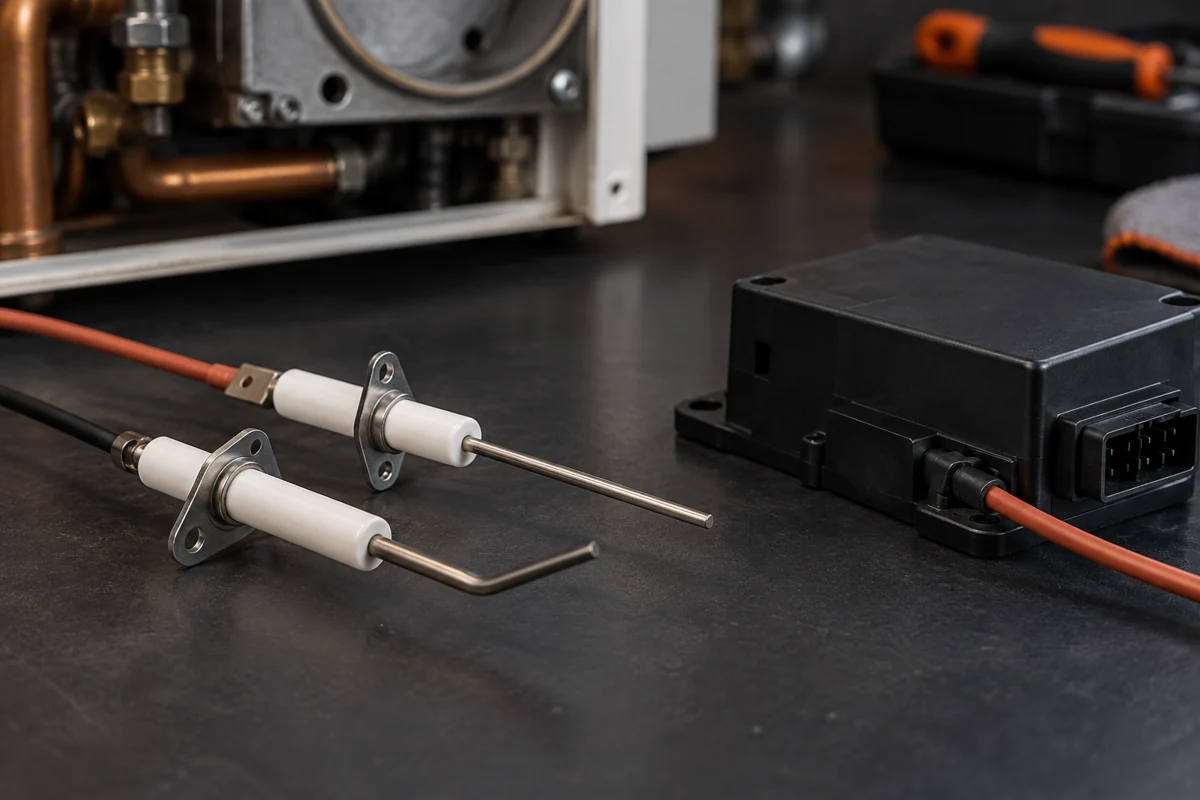
Spark-ignition systems use an electrode arrangement to establish ignition and a method of verifying flame. Ceramic insulation, positioning, wiring, grounding, and the relevant control can matter to operation. The correct assessment uses the model’s specifications. Cleaning, adjusting, or replacing an electrode is not a universal homeowner maintenance step, especially where access requires opening a combustion enclosure.
Hot-surface ignition
A hot-surface igniter becomes hot enough to support ignition in a controlled sequence. These parts can be fragile and are not interchangeable merely because their connectors look similar. A qualified provider should verify the supply and control sequence, determine whether the part failed, and use the specified replacement. Handling or energizing an exposed igniter is not a safe way to test it at home.
03 / SERVICE GUIDE
Diagnosis should follow the sequence
Verify the request and safety permissions
The provider should identify the boiler model and determine whether its controls permit an ignition attempt. This includes understanding the relevant operating and protective inputs, not bypassing them to make the burner run. A failed permission can point to a real system condition. The quotation should explain whether the investigation found a failed device or a device responding correctly to another fault.
Observe the manufacturer-defined startup
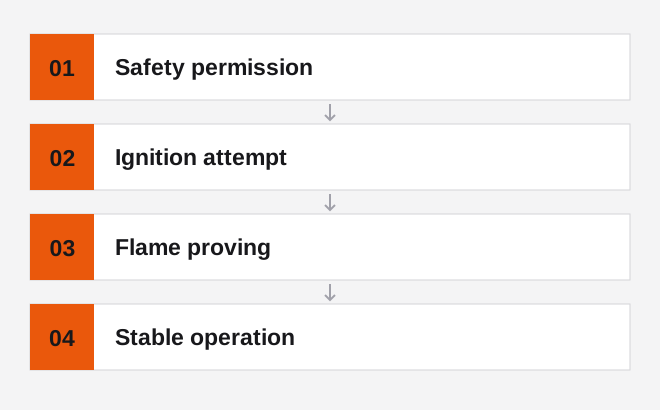
A qualified technician can compare the actual sequence with the correct documentation: the request, any preliminary operation, ignition, fuel admission, flame proving, and transition to normal running. Not every appliance uses the same order or components. The homeowner’s role is to report what was externally visible, while the provider performs the measurements and internal observations needed for diagnosis.
Test the suspect component in context
A sensor, electrode, cable, or control should be assessed with its surrounding conditions in mind. A poor connection or an upstream problem can imitate a defective part. Ask what evidence established the failure and whether the replacement addresses the reason it occurred. If the explanation is simply “the code mentions ignition,” request more detail before approving an expensive assembly.
Check reliable operation after the work
Successful ignition once is useful but may not reproduce an intermittent complaint. The provider should carry out the checks required for the specific repair and assess operation under relevant conditions. Ask whether the original shutdown pattern was resolved, what safety or combustion checks were performed, and whether any unrelated defect remains. Keep the model-specific service record with the appliance documents.
04 / SERVICE GUIDE
Never force a failed ignition sequence
Repeated reset attempts are not a diagnosis. Stop and seek qualified help when the boiler repeatedly locks out or behaves abnormally. Do not bypass flame supervision, bridge protective switches, alter gas settings, or use an external flame to light equipment that is not designed for that procedure. A video showing another boiler does not establish a safe procedure for yours.
If you smell gas or a carbon monoxide alarm operates, leave the premises and contact emergency services or your utility from a safe place. Do not wait beside the boiler for another ignition attempt, and do not operate switches to see whether the fault clears. An online request is suitable for arranging service, not for managing an immediate gas or combustion emergency.
Ready to discuss your heating problem?
Share the symptoms and confirm the next step with an independent provider.
05 / SERVICE GUIDE
Information that helps identify an intermittent fault
Intermittent problems are easier to investigate when the provider has a specific pattern. Note whether the boiler fails only after being idle, after a long run, or at unpredictable times. Record any externally displayed message exactly, including whether it disappears after the appliance stops. Mention recent power interruptions, servicing, or work near the boiler, without assuming those events caused the fault.
If another person witnessed the behavior, combine the observations before the visit. “It clicks three times and shows a code” is different from “the thermostat never seems to call.” Do not remove panels to improve the description. Access to combustion equipment and electrical tests should remain with the qualified service professional.
06 / SERVICE GUIDE
Repair decisions and recurrence
A repair may involve a small ignition-related component, wiring correction, a control assembly, or another system issue preventing ignition. Confirm the part specification, diagnostic charge, and any additional required work. Ask whether the provider found evidence of wear, contamination, connection failure, or an external operating problem. The answer helps distinguish a durable repair from repeated replacement of the same symptom.
If a similar fault returns, provide the prior invoice and the original code rather than assuming the replacement part has failed again. The new event may occur at a different stage of the sequence. A clear record of dates, symptoms, and previous findings supports a more focused follow-up and helps the provider explain what remains uncertain.
07 / SERVICE GUIDE
Pilot and ignition questions
My boiler has no visible pilot. Is something missing?
Not necessarily. Many boilers ignite only when needed and do not have a standing pilot. Do not open the appliance to search for one. Identify the model from an accessible label or documentation and ask the provider which ignition arrangement it uses.
Can I replace a flame sensor myself?
This page does not recommend internal ignition work by homeowners. Access may expose electrical and combustion hazards, and diagnosis requires more than recognizing a part. A suitable provider should verify the fault, install the correct component if needed, and complete the required operating checks.
Why does a reset sometimes make the boiler work?
A reset can clear a recorded shutdown without removing its cause. The apparent recovery may depend on conditions that have temporarily changed. Tell the provider how often this happens and what code appears. Recurring lockouts need investigation even if heat occasionally returns.
Is this service relevant to an oil burner?
Oil burners also require ignition and flame supervision, but their fuel and control arrangements differ. Use the oil and steam service guide to describe that system. For gas equipment, include the model and sequence in Request Service; an independent provider will confirm suitability and availability.
Sources & further reading
Manufacturer references illustrate model-specific requirements. Use the manual for your own equipment; these references are not universal repair instructions.
Take the next step.
Tell us where help is needed and what your system is doing.