
Medford, Massachusetts / Radiator & Baseboard Heating Repair
Radiator & Baseboard Heating Repair in Medford
Find help for cold radiators, uneven zones, and hydronic baseboard problems in Medford. Understand the checks behind a targeted repair.
- System-specific guidance
- Clear repair questions
- You approve the work
Know what to ask
Start with the right diagnosis
A room that never warms up is not automatically evidence that the boiler needs replacement. Heat must travel from the appliance through the correct circuit and leave the radiator or baseboard effectively. Controls, water or steam movement, valves, emitter condition, and room conditions all influence the result. A useful assessment separates a single cold emitter from a cold zone or a whole-building heating problem before selecting a repair.
01 / SERVICE GUIDE
Map the comfort complaint
One radiator is colder than the others
Identify whether the room has its own thermostat or shares one with warmer rooms. Describe whether the emitter stays completely cold or warms only partly. A provider may need to assess the valve, air or venting arrangement, local circulation, or the emitter itself. Do not assume that every uneven radiator contains trapped air; the system type determines which explanations and procedures are appropriate.
Several rooms on one circuit lag behind
A group of cold rooms can direct attention to their common zone valve, circulator, thermostat, or distribution path. Recent remodeling or a disconnected emitter may also be relevant. Tell the provider which rooms respond together and whether the boiler continues running while they remain cold. This is more useful than reporting only the temperature of the coldest room.
The emitter is warm, but the room is uncomfortable
Heat delivery and building heat loss are related but distinct questions. Obstructed baseboard airflow, furniture placement, controls, or the room’s envelope may contribute. A warm emitter does not prove it is delivering the required output, and a cold room does not prove the boiler has failed. The provider should explain whether the proposed work concerns distribution, controls, emitter performance, or the room itself.
02 / SERVICE GUIDE
The heating type changes the diagnosis
Hot-water radiators
Hydronic radiators circulate heated water through a closed distribution arrangement. Depending on the installation, air management, flow balance, valve operation, or a local restriction may need assessment. The provider should understand the circuit layout before opening or adjusting components. Bleeding advice is not universal, and introducing water afterward without understanding the system can create a different problem.
Steam radiators
Steam emitters rely on the intended movement of steam, air, and condensate. One-pipe and two-pipe systems use different arrangements, so vent and valve recommendations must match the installation. A provider may investigate how air leaves and condensate returns rather than apply hydronic balancing assumptions. Do not loosen a steam fitting or replace a vent with an arbitrary alternative based on its appearance.
Hydronic baseboard
Fin-tube baseboard uses water flow and air movement around heated fins to warm the room. The cover and surrounding space are part of its operating environment. Damage, obstruction, or changes to the circuit can affect performance. Tell the provider about recent flooring, cabinetry, or furniture changes as well as the heating symptom. Electric baseboard is a different system and may require a different service trade.
03 / SERVICE GUIDE
A room-by-room diagnostic approach
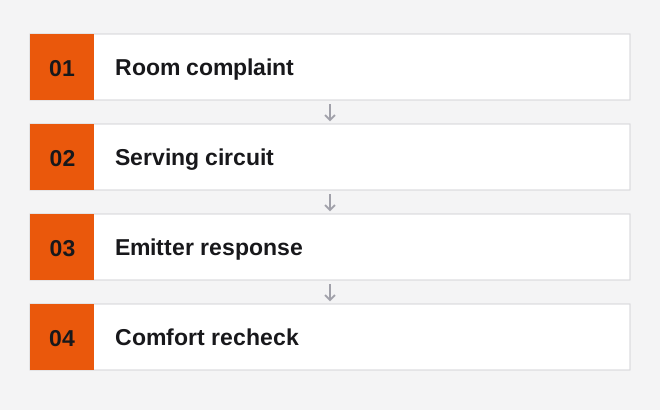
Establish the complaint under real conditions
Record the thermostat setting, which rooms are affected, and whether the problem appears only in colder weather or throughout the heating season. Avoid changing several controls immediately before a visit without recording the original settings. The provider needs to distinguish a persistent distribution issue from an occasional scheduling or control conflict.
Trace the serving circuit
The professional should identify which boiler, zone, pump, valve, or steam main serves the affected emitters. In a divided house or a remodeled property, physical proximity does not reliably identify the circuit. Existing labels may be incomplete. A circuit map can prevent work on an unrelated valve and helps connect a room complaint to the equipment responsible for serving it.
Compare delivery and emitter behavior
Appropriate professional checks may compare supply and return conditions, valve response, or the progression of warming across the relevant system. The interpretation depends on the design and current demand. A single touch test is not enough to establish flow or output, and surfaces may be hot. Ask the provider to explain the observed pattern rather than report only that a pipe felt warm.
Recheck the affected rooms
After repair or adjustment, verify the original zone or emitter complaint rather than only confirm that the boiler starts. Some systems need time to demonstrate their response. Ask which settings changed and whether a follow-up observation is useful. Record any room that still fails to warm so a partial improvement is not mistaken for complete resolution.
04 / SERVICE GUIDE
Noises, leaks, and repeated air complaints
Clicking or expansion sounds, gurgling, steam-related banging, and leaking valve stems are different symptoms. Note where the sound occurs and whether it accompanies startup, steady heating, or shutdown. A provider should relate the sound to the actual system arrangement. Turning pressure or temperature upward without a diagnosis can obscure the complaint rather than solve it.
If emitters repeatedly need attention after apparent bleeding or refilling, report that history. The provider may need to investigate water loss, air entry, or the installation’s air-management arrangement instead of treating each cold radiator separately. Visible leaks belong in the same conversation because boiler leak and pressure problems can affect distribution performance.
Ready to discuss your heating problem?
Share the symptoms and confirm the next step with an independent provider.
05 / SERVICE GUIDE
Homeowner precautions around emitters
Radiators, valves, baseboard piping, and steam vents may be hot enough to burn. Do not open hot fittings, force a stuck valve, remove a steam vent during operation, or reach into electrical controls. Keep children and pets away from leaking or unusually hot components. If a leak threatens electrical equipment, avoid the wet area and obtain appropriate assistance rather than stepping through water to reach a switch.
You can safely describe room patterns and note visible obstructions without dismantling the heating system. Any owner maintenance should follow the instructions for the exact equipment. Suspected damaged or unidentified old insulation should be left undisturbed and raised with the provider. The purpose of the initial observations is to improve the service conversation, not to turn occupants into repair technicians.
06 / SERVICE GUIDE
Choosing between adjustment, repair, and replacement
A recommendation should distinguish a defective component from an unsuitable setting or a design limitation. Repairing a valve, correcting a zone-control problem, cleaning an appropriate component, and replacing an emitter have different consequences. Ask how the proposal addresses the observed fault and whether it changes the balance of the rest of the circuit.
If an addition or converted room lacks sufficient heating provision, replacing the boiler may not be the first relevant answer. The provider may need a broader assessment of emitter capacity, distribution, and the room’s heat loss. Conversely, adding a larger radiator without understanding the system can create new imbalance. Request a reasoned scope rather than selecting equipment solely by its physical size.
07 / SERVICE GUIDE
Arrange access to the whole affected zone
Make a list of rooms that need inspection and arrange permission to enter them. In a multifamily property, the controlling thermostat, affected radiator, and mechanical room may be in different areas. The provider may be unable to establish the full pattern if only the basement is accessible. Identify who can approve work on shared components before booking.
Include recent changes such as a radiator removed during renovation, newly enclosed baseboard, or altered thermostat schedules. These are useful clues even when the problem began later. Keep the final circuit notes and changed settings with the property records so future visits do not repeat the same mapping work.
08 / SERVICE GUIDE
Radiator and baseboard questions
Should every radiator feel equally hot?
Not necessarily. System design, demand, valve settings, and room conditions affect surface temperatures. The useful question is whether the rooms receive appropriate heat under the operating conditions. A provider should investigate the comfort complaint and the distribution pattern rather than pursue identical touch temperatures everywhere.
Can furniture affect baseboard performance?
Furniture or coverings that obstruct the intended airflow can affect room heating. Review the equipment’s clearance guidance and tell the provider about recent room changes. Do not remove protective covers or modify fins as a substitute for understanding the installation’s requirements.
Do cold spots prove that power flushing is needed?
No. Restrictions are one possible explanation among several. Valve, control, circulation, or venting issues may require a different response. See maintenance and power flushing for the assessment questions to ask before agreeing to cleaning.
How do I request the right service?
Use Request Service and state whether the emitters are steam radiators, hot-water radiators, hydronic baseboard, or an unknown type. Describe the affected rooms and any leaks or noise. An independent provider will confirm the appropriate scope and availability; this website does not perform the repairs.
Sources & further reading
Manufacturer references illustrate model-specific requirements. Use the manual for your own equipment; these references are not universal repair instructions.
Take the next step.
Tell us where help is needed and what your system is doing.