
Shared buildings & household coordination
Boiler Repair in South Medford
Prepare a South Medford boiler request for separate or shared heating systems, with practical access, approval, and apartment-level diagnostic guidance.
- System-specific guidance
- Clear repair questions
- You approve the work
Your property, understood
A practical guide for your address
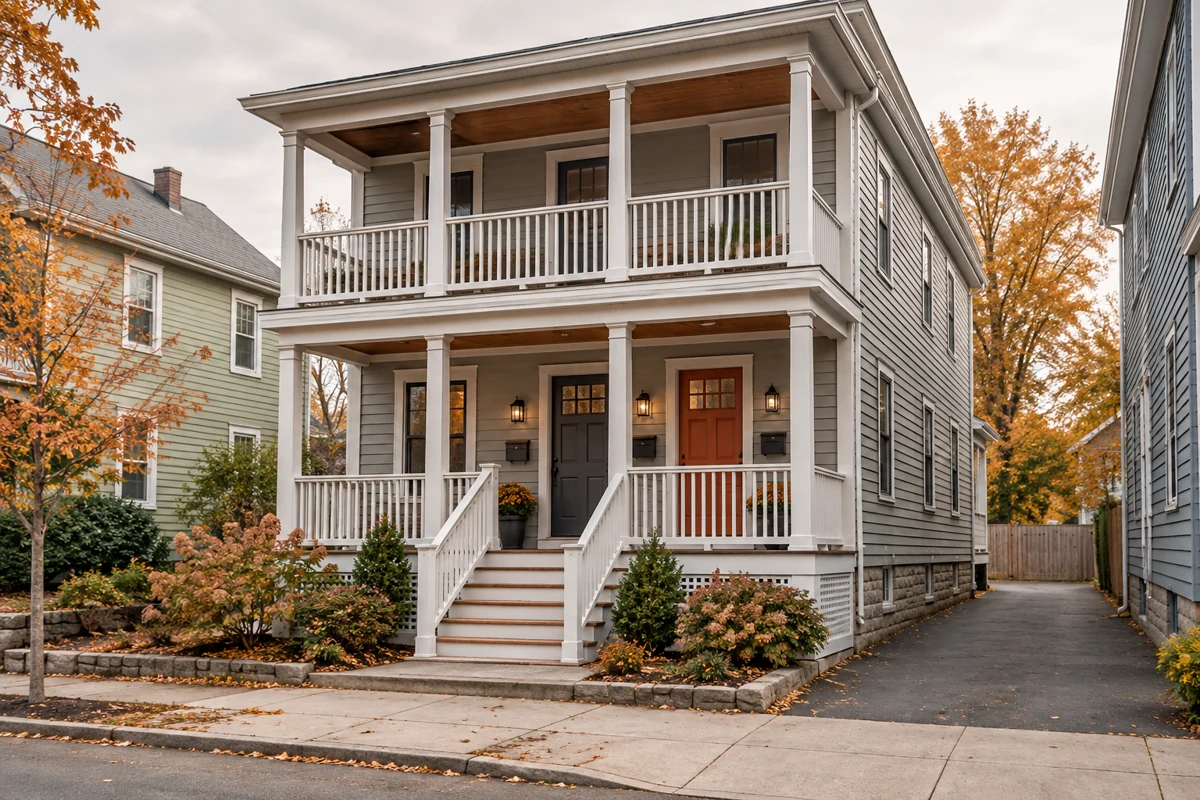
In a property with more than one household, “the heat is not working” can mean one apartment is cold while another is comfortable, one thermostat is misunderstood, or a shared plant has stopped altogether. South Medford’s documented mix of single-family houses, two-family buildings, and some three-deckers makes that distinction a useful starting point. The actual heating arrangement must still be confirmed at the property; housing form does not prove whether equipment is shared or separate.
01 / LOCAL GUIDE
Begin with the affected household, not an assumed boiler
The Historical Commission’s South Medford survey describes varied residential development, including stacked-flat housing. Its account is a source for neighborhood building context, not a record of current boilers or ownership responsibilities. A converted or renovated property can have equipment and controls that differ substantially from the layout suggested by its front doors or porches.
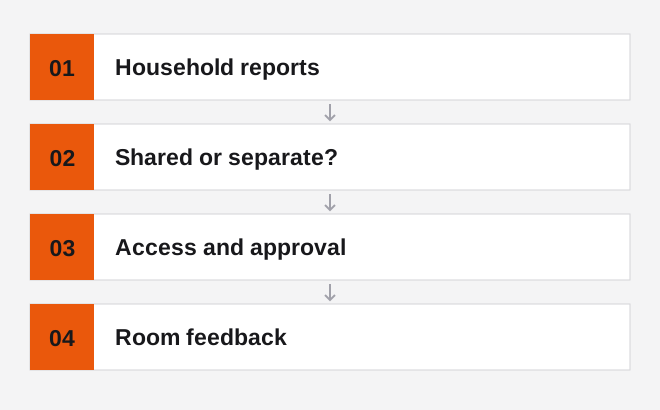
When requesting help, identify the apartment or occupied area, the thermostat used, and whether other households report the same issue. Explain whether the responsible owner or manager has already been informed. Those practical details help avoid a visit that reaches the basement but cannot access the affected rooms or obtain approval for work on shared equipment.
02 / LOCAL GUIDE
Three possible arrangements to distinguish
Separate appliances for separate households
Several boilers may occupy one utility space. Labels can be missing, outdated, or inconsistent with present apartment names. Do not turn equipment off experimentally to determine which household it serves. A professional should identify the relevant appliance and connected controls. Provide the apartment’s complaint and any established equipment identifier instead of relying on the nearest boiler or the clearest handwritten label.
One boiler with several controlled zones
A shared heat source may serve separate circuits. A fault in one thermostat, zone valve, or pump can affect a subset of rooms without stopping the whole building. Reports from all affected occupants are useful, but their observations should remain separate. Combining them into “everyone has no heat” when the symptoms differ can direct the investigation away from the actual serving circuit.
A shared system with limited local control
Some properties may have a single control arrangement serving several occupied areas. The relationship between thermostat location, schedules, and room comfort then deserves attention. An occupant’s adjustment may influence more than their own rooms. The provider needs to understand the installed arrangement and the owner’s operating requirements before recommending control changes or treating every complaint as a broken radiator.
03 / LOCAL GUIDE
Coordinate a productive visit
Assemble one clear symptom record
Ask each affected household for the rooms involved, the time of the problem, and whether domestic hot water is also affected. Keep factual observations distinct from proposed explanations. A resident may reasonably describe clicking, water, or cold emitters without knowing the boiler type. The manager can combine those observations into a timeline without converting guesses into a diagnosis.
Confirm access to connected spaces
The thermostat, cold emitter, boiler, and relevant valve may be behind different doors. Arrange access with the appropriate occupants and explain what the provider may need to inspect. Do not assume entry permission for one unit covers another. Where access is unavailable, ask how that limitation affects the diagnosis and whether a further visit could be required.
Identify the approval contact
The person reporting the fault may not be authorized to approve repairs to shared equipment. Establish who accepts the diagnostic charge and who can authorize additional scope. This is an operational preparation step, not legal advice about landlord or tenant obligations. If responsibility is disputed, obtain appropriate guidance rather than asking a repair technician to resolve the ownership arrangement.
Communicate the restoration plan
If work requires an interruption, the responsible property contact should coordinate with affected occupants. Ask the provider which functions will be unavailable and how completion will be communicated. Afterward, collect feedback from the rooms originally reported cold. A successful boiler start does not establish that every affected apartment or zone has recovered.
04 / LOCAL GUIDE
A hypothetical two-household diagnostic example
Imagine an upstairs household reports cold bedrooms while the lower household reports normal heating. This is not proof of a small boiler or a particular pump failure. A professional first needs to determine whether the households share equipment and whether the cold rooms belong to one circuit. The control request and actual distribution response can then be assessed together.
If separate boilers are installed, the investigation may concern only the upstairs appliance. If a central boiler serves zones, the relevant zone controls and flow path become important. If there is one shared control, the provider may need to evaluate room response and operating strategy. The example is a planning aid, not a South Medford project or a claim about a specific address.
Ready to discuss your heating problem?
Share the symptoms and confirm the next step with an independent provider.
05 / LOCAL GUIDE
Room-level symptoms need precise descriptions
For a radiator complaint, record whether the entire emitter stays cold, whether only part warms, and whether a nearby emitter responds. The provider must establish whether the system uses steam or hot water before selecting an approach. Occupants should not loosen vents or fittings based on general internet advice. Steam and hot-water emitters have different air-management arrangements.
For tap-water complaints, explain whether the problem occurs at every outlet or only one fixture, and whether simultaneous use changes the result. A combination boiler, a separate water heater, and a shared domestic-water arrangement can require different assessments. The gas and combi service guide helps distinguish space-heating complaints from domestic hot-water faults without assuming that the same equipment serves both.
06 / LOCAL GUIDE
Shared utility-space considerations
Equipment identification
Ask the provider to document the appliance and circuit involved in the repair. A usable record should identify the served area rather than only “basement boiler.” This becomes particularly valuable when a different contractor attends later. Clear labeling should follow verified connections, not be added from assumptions about which appliance corresponds to which apartment.
Storage and working access
Keep a safe access route available and tell occupants before their belongings need to be moved. Do not place stored items against hot surfaces or obstruct equipment openings. If the provider identifies an access problem, discuss a suitable solution rather than asking them to work around an unsafe obstruction. Requirements depend on the actual equipment and installation.
Leaks that cross boundaries
Water seen in one apartment may originate in a pipe serving another area. Report the first visible location and when it occurs without opening finishes yourself. The leak and pressure page describes why identifying the source and fluid circuit matters. Confirm who can authorize any investigation that extends beyond the initially affected room.
07 / LOCAL GUIDE
Plan follow-up without repeating the same assumptions
After a repair, retain the findings and communicate relevant operating instructions to the people using the controls. If a problem returns, ask occupants to report the new timing and symptoms rather than simply repeat the previous diagnosis. The event may involve the same component, another zone, or a different operating condition.
For persistent comfort differences, ask whether a separate controls or distribution review is appropriate. That work should be distinguished from an urgent repair and explained on its own merits. A provider should not promise identical room conditions merely by increasing boiler settings without assessing how the building is served.
08 / LOCAL GUIDE
Shared-building safety
If there is a suspected gas escape, smoke, or a carbon monoxide alarm, leave the affected building and contact emergency responders or the utility from a safe place. Do not wait for the approval contact before responding to immediate danger. Avoid wet electrical areas and hot discharge. Online service requests are not emergency dispatch and should not delay an evacuation or emergency call.
09 / LOCAL GUIDE
South Medford service questions
Can a tenant report a heating problem here?
Yes, a tenant can describe the issue and seek information, but the provider will need appropriate authorization for inspection and repairs. Involve the responsible property contact and explain which spaces are accessible. Do not authorize changes to shared equipment on the assumption that a service request establishes ownership permission.
Why does the provider need access to a warm apartment?
Comparing affected and unaffected areas may help identify circuit boundaries or control behavior. The need depends on the installation and complaint. Arrange access through the proper property contact and ask the provider to explain what information the comparison is intended to establish.
Do stacked porches mean the building has separate boilers?
No. Exterior form does not determine the present heating arrangement. The Historical Commission’s housing descriptions provide neighborhood context, not mechanical records. The equipment and its served areas must be identified directly.
How do we request a coordinated appointment?
Use Request Service with the address, affected unit or rooms, equipment information, and approval contact. For distribution symptoms, read radiator and baseboard repair. Independent providers confirm availability and terms; Boiler Repair Pro supplies the referral connection rather than a repair workforce.
Sources & further reading
Neighborhood sources establish building context, not current heating installations or provider coverage.
Take the next step.
Tell us where help is needed and what your system is doing.