
Older homes & altered heating layouts
Boiler Repair in West Medford
Plan boiler repairs in West Medford with guidance on older radiators, later additions, fuel conversions, and focused service preparation.
- System-specific guidance
- Clear repair questions
- You approve the work

Your property, understood
A practical guide for your address
For a West Medford home with an older heating distribution system, a useful repair conversation begins with what the building has become, not just when it was built. A replacement boiler may serve radiators retained through several renovations; an added room may use a separate circuit; and a previous fuel conversion may leave a confusing service history. Those are possibilities to investigate at the property, not assumptions about every house in the neighborhood.
01 / LOCAL GUIDE
A neighborhood with several layers of housing history
The Medford Historical Commission’s West Medford overview documents early houses, nineteenth-century subdivisions, and later residential development. That varied history supports a practical point: an exterior style cannot identify the heating equipment inside. A house that looks historic may contain a recent boiler, while a later addition may remain connected to older distribution. The source describes buildings and development, not a survey of present-day heating systems.
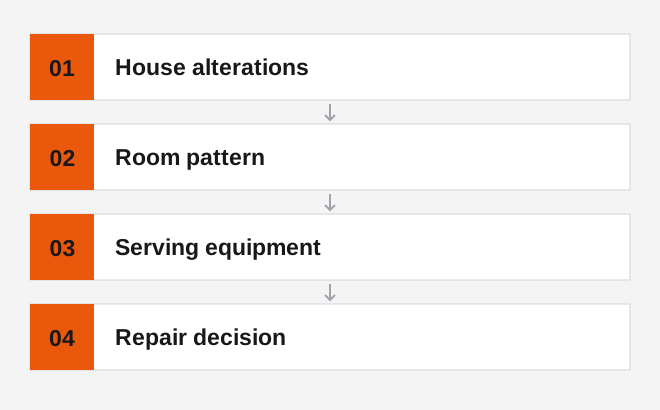
For owners, the most useful preparation is a brief alteration history. Note when the boiler was replaced, whether the fuel changed, and which rooms were added or remodeled. If the records are incomplete, say so. A provider can work from evidence at the installation rather than treating a presumed original layout as fact.
02 / LOCAL GUIDE
Separate the appliance from the inherited system
A newer boiler serving older radiators
The boiler’s age and the radiators’ age need not match. A comfort complaint may involve controls, circulation, or the distribution arrangement rather than the newer appliance itself. Identify whether the boiler operates normally while certain rooms remain cold. Ask the provider to explain which part of the system the proposed work addresses and why that part accounts for the reported pattern.
A room added after the original house
An addition may have a different exposure, insulation level, or heating circuit from the main rooms. If it is consistently colder, record whether its emitters warm and whether it shares a thermostat with a more comfortable area. A larger boiler is not automatically the answer. The relevant question may be how heat reaches that room and whether the installed emitter arrangement suits its needs.
Evidence of a previous fuel conversion
Old invoices, labels, or disconnected equipment may suggest earlier changes, but they should not be used to guess the current operating arrangement. Give the provider the current appliance and burner details where visible. The professional can establish what remains active and whether any existing venting, controls, or connections need attention as part of the actual complaint.
03 / LOCAL GUIDE
Build a useful comfort map
Record rooms in their normal use
List which occupied rooms lag behind, which become comfortable, and which thermostat controls them if known. Use ordinary room names rather than speculative pipe labels. Keep the heating schedule unchanged long enough to describe the usual pattern. A provider gains more from “the rear bedroom stays cold while the front rooms heat” than from an unsupported conclusion that the pump is undersized.
Add the timing of the problem
Explain whether the complaint appears only during colder weather, after a setback period, or every time the system runs. If the problem began after a renovation, include that date and what was altered. Timing helps distinguish a long-standing distribution limitation from a sudden component failure. It also helps the provider decide what conditions may be needed to reproduce the complaint.
Connect observations to service records
Bring together prior repair invoices, model information, and any notes about radiator or thermostat changes. Do not discard older records merely because the boiler was replaced; they may describe distribution that remains in use. Ask the provider to mark what was confirmed during the current visit so uncertain history does not become an apparently verified fact in the next report.
04 / LOCAL GUIDE
A worked diagnostic scenario, not a claimed local job
Consider a hypothetical detached house where the boiler starts, the front rooms warm, and a remodeled rear room stays uncomfortable. The first question is not whether the entire boiler should be replaced. The provider needs to establish which circuit serves the room, whether its emitter receives heat, and whether a control or room-specific limitation is involved. These are distinct branches of the investigation.
If the emitter remains cold, the serving circuit, valve, or circulation path deserves assessment. If it becomes warm but the room remains cold, output and room conditions may need a broader review. This example illustrates how to organize a service discussion; it is not evidence that Boiler Repair Pro performed work in West Medford or that all rear additions share the same defect.
Ready to discuss your heating problem?
Share the symptoms and confirm the next step with an independent provider.
05 / LOCAL GUIDE
Care around older finishes and utility spaces
Access planning matters when heating components sit behind later finishes or in a crowded basement. Tell the provider about narrow access, locked spaces, and areas you do not want disturbed without discussion. A repair quotation should distinguish the heating work from opening or restoring building finishes. Do not assume that a small visible valve can be reached without other work.
Leave unidentified old insulation untouched. If it appears damaged or may obstruct the proposed repair, disclose that before work starts so the appropriate assessment can be arranged. Homeowners should not strip pipe covering to expose a leak for photographs. The useful observation is the location and extent of visible moisture, not a close-up obtained by disturbing unknown material.
06 / LOCAL GUIDE
Choose the service by what changed
Water appears near the boiler or a radiator
State whether the moisture occurs continuously or during heating and whether a gauge reading changes. The source may be away from where water collects. The leak and pressure guide explains what an independent provider should distinguish before recommending a repair. Avoid repeated refilling as a substitute for finding recurring water loss.
Radiators heat unevenly
Identify whether your emitters use steam or hot water if that is known. Do not transfer a bleeding procedure from one system to another. The radiator and baseboard guide focuses on local emitter faults, zone problems, and the difference between warm equipment and adequate room comfort.
The burner repeatedly stops
Preserve the fault code and the sequence visible from outside the appliance. The ignition service page explains why a control message does not automatically identify a replacement part. A recurring lockout needs assessment; repeatedly resetting it can conceal the pattern and is not a sound diagnostic method.
07 / LOCAL GUIDE
Set the scope before authorizing work
For a West Medford property with several generations of alterations, ask the provider to separate the confirmed fault from broader improvement suggestions. The immediate repair may be limited, while a distribution or controls review could be a separate project. Obtain an explanation of each recommendation rather than a single package that blends urgent work with optional changes.
Confirm the diagnostic charge, access arrangements, and the person who can approve additional work. If the provider cannot fully reproduce an intermittent symptom, the record should say so. A transparent account of uncertainty is more useful than a confident diagnosis unsupported by the visit. Keep the final findings with your home’s alteration and maintenance documents.
08 / LOCAL GUIDE
When the situation is unsafe
Do not remain inside to gather heating details if there is a gas odor, smoke, or a carbon monoxide alarm. Leave and contact the appropriate emergency service or gas utility from a safe location. Around ordinary heating faults, avoid hot valves, steam discharge, and electrical equipment exposed to water. A service request should describe observations made safely, not the results of attempted internal repair.
09 / LOCAL GUIDE
West Medford homeowner questions
Does an older-looking house necessarily have steam heat?
No. Building appearance and construction era do not establish the current fuel or distribution system. Renovations and replacements may have changed both. Supply the current model information and let the provider identify the installation rather than ordering service on an architectural assumption.
Should I replace radiators when replacing a boiler?
Not automatically. The existing emitters and distribution need assessment for condition, compatibility, and performance. Ask the provider to explain why any proposed replacement is necessary and whether a separate issue, such as a valve or circuit problem, accounts for the complaint.
Is West Medford coverage guaranteed?
No. Give your full service address and system details so an independent provider can confirm whether they can attend and what work they handle. This page is a neighborhood guide, not a claim of an office, dedicated crew, or guaranteed appointment window.
What should I send with my request?
Include the affected rooms, recent alterations, fuel if known, and any externally visible code or leak. Use Request Service or return to the Medford boiler repair overview. Boiler Repair Pro connects customers with independent service providers; the provider diagnoses the system, sets charges, and performs any authorized repair.
Sources & further reading
Neighborhood sources establish building context, not current heating installations or provider coverage.
Take the next step.
Tell us where help is needed and what your system is doing.