
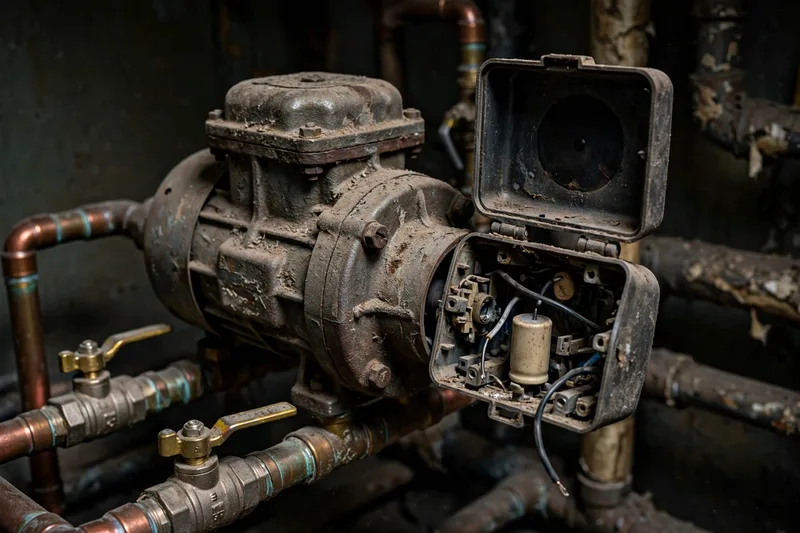
A circulator pump that will not start leaves radiators cold even while the boiler fires normally. Here is what usually causes it and what to check before you call.
Start with the simple checks — thermostat, power, and controls — before assuming the pump itself has failed.
Short answer
A circulator pump that will not start is usually suffering from a failed motor, a seized bearing, no electrical supply, or a control fault that never tells it to run. Less often, a severe airlock or a closed service valve stops flow so completely that the pump appears dead. The pattern of symptoms — silence versus humming, one cold zone versus a cold house — points toward which cause is most likely.
Before calling, confirm the thermostat is actually calling for heat, check the breaker, and listen at the pump. Those three checks separate a five-minute fix from a part replacement.
The most common causes
Failed motor. Pump motors wear out. A motor that has failed electrically is silent — no hum, no vibration — even with power reaching it. This is the most common end-of-life failure.
Seized bearing or rotor. When bearings seize, the motor cannot turn the impeller. You may hear a loud hum or buzz as the motor strains against the seized rotor, then a thermal cutout trips and it goes silent. Some pumps can be freed; many cannot.
No electrical supply. A tripped breaker, a blown fuse, a failed relay, or loose wiring means the pump never receives power. The pump itself may be perfectly fine.
Control fault. The thermostat, aquastat, relay, or zone control may never send the run signal. The pump is healthy but never told to start — common after control work or thermostat replacement.
Closed service valves. If isolation valves on either side of the pump were closed during maintenance and never reopened, the pump runs against a dead head or the system behaves as though the pump is dead.
Safe checks you can do
Turn the thermostat up several degrees and confirm it clicks and calls for heat. Check the breaker panel for a tripped breaker serving the boiler circuit. Put your hand on the pump (carefully — it may be hot) and listen: silence suggests no power or a dead motor, while a loud hum suggests a seized rotor drawing current.
Look at any zone valves on the affected loop — a closed valve mimics a dead pump for that zone. If you recently had work done, check whether service valves near the pump are open. Do not open electrical enclosures, bypass safeties, or force a seized pump with tools.
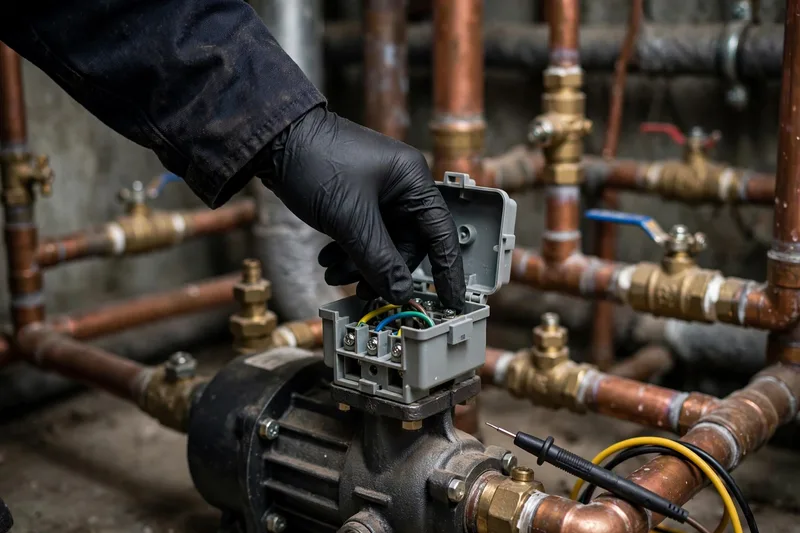
Pump failure versus control failure
This distinction matters because the fix is completely different. A dead pump needs a pump repair or replacement. A control fault needs electrical diagnosis. A provider separates them by verifying voltage at the pump: power present but no movement means the pump; no power means the investigation moves upstream to the relay, thermostat, and wiring.
If every zone is cold and the boiler fires, suspect the pump or its supply. If one zone is cold while others heat, the zone valve or its control is more likely — see zone valve and circulation problems.
What the provider will test
A provider checks supply voltage at the pump, tests the capacitor on capacitor-start motors, tries to turn the rotor by hand (with power off) to detect seizure, and verifies the control chain from thermostat to relay. If the pump is seized or the motor has failed electrically, the conversation turns to repair versus replacement of the pump itself.
For professional diagnosis, see circulator pump repair in Medford.
Related service pages
For a commercial next step, see circulator pump repair in Medford. Related reading includes zone valve and circulation problems and zone valve and circulation repair.
When a silent pump is urgent
A dead pump in freezing weather is urgent — without circulation, pipes can freeze even with the boiler firing. If the house is losing heat and the pump will not start, call promptly rather than waiting for morning. For the full range of heating guides, see the Boiler Repair Pro homepage.
Pump won't start and the house is cooling?
Describe the symptoms — silence, humming, or a tripped breaker — and a local provider will diagnose whether it's the pump or the controls.